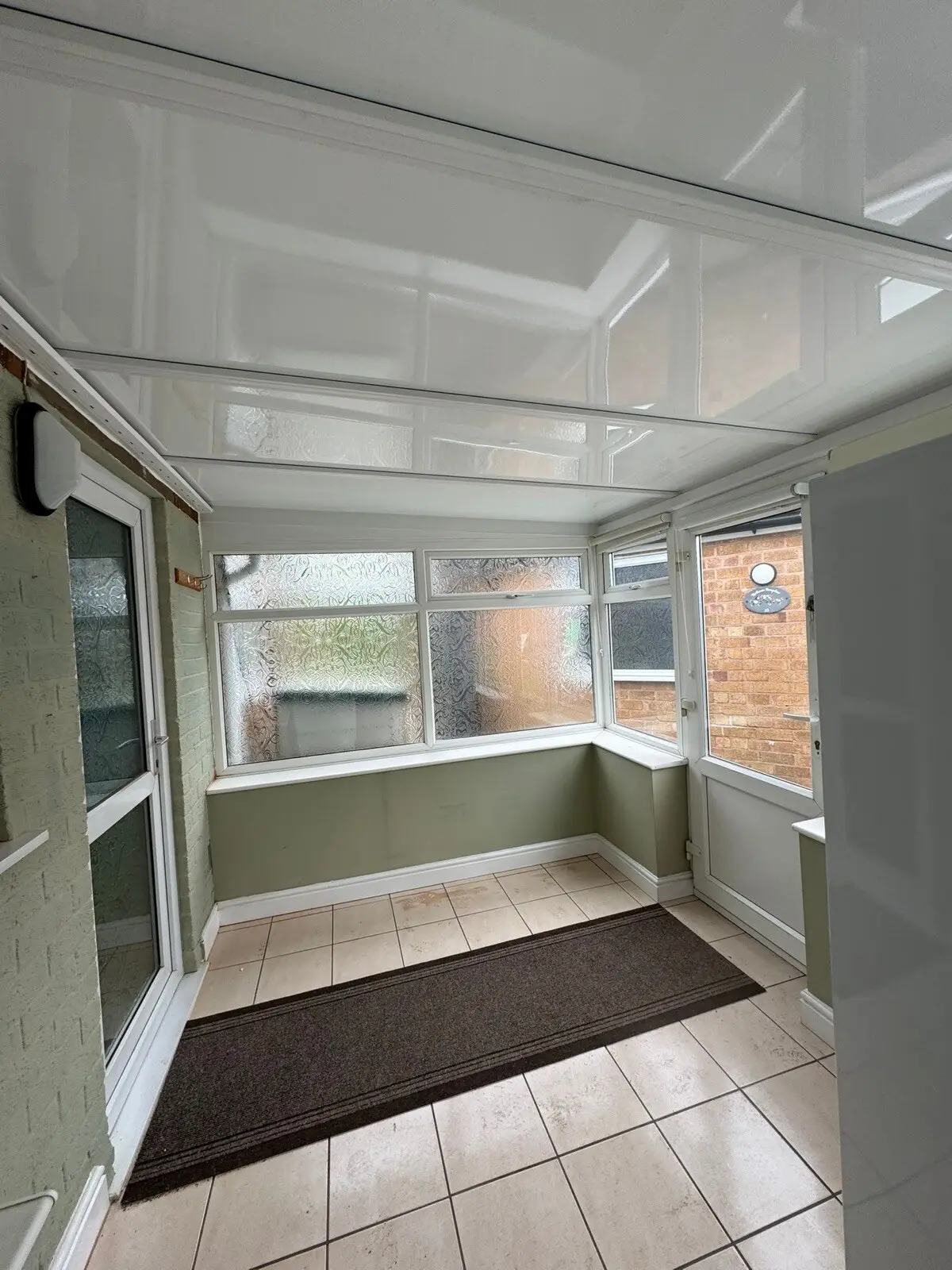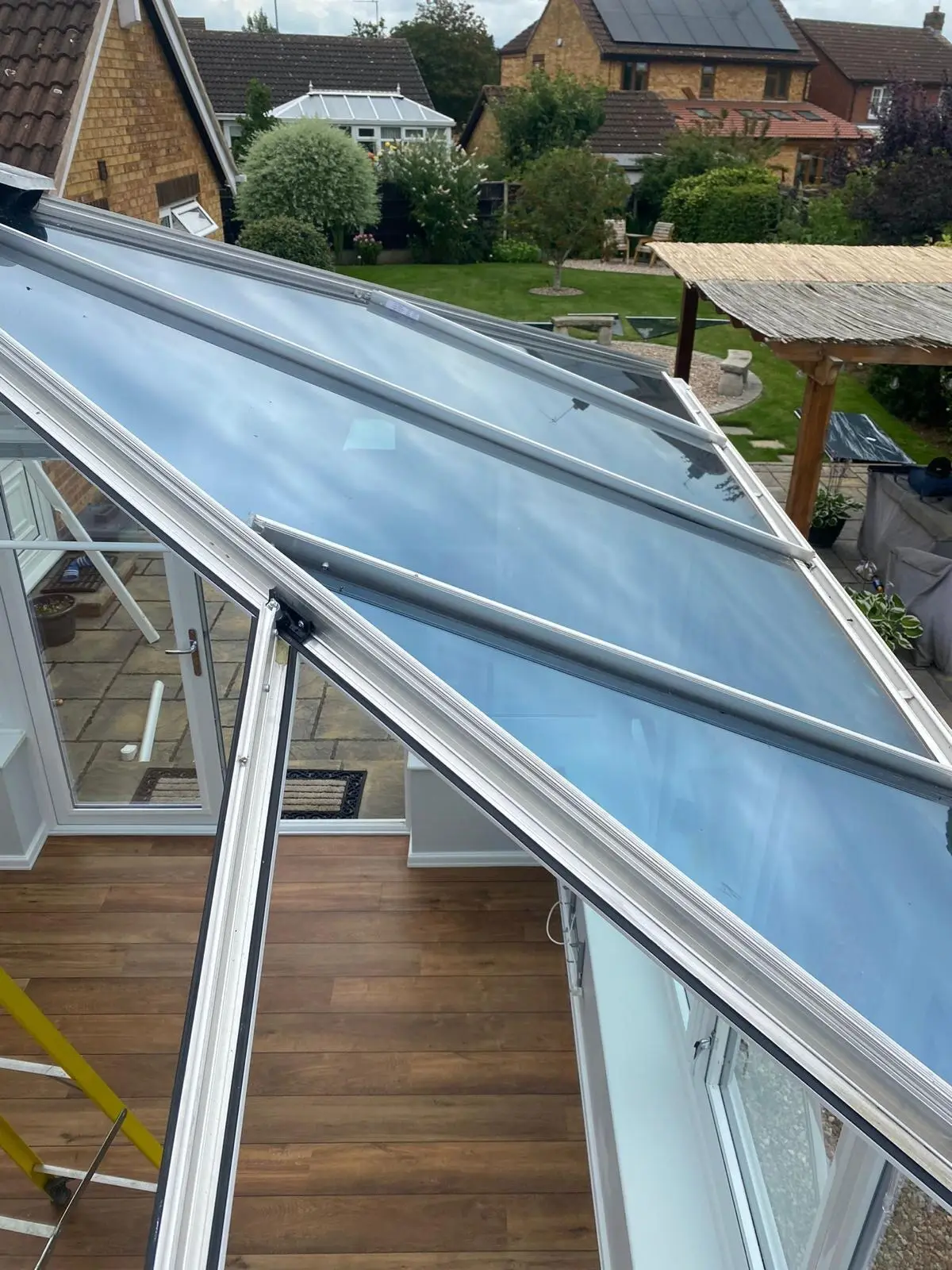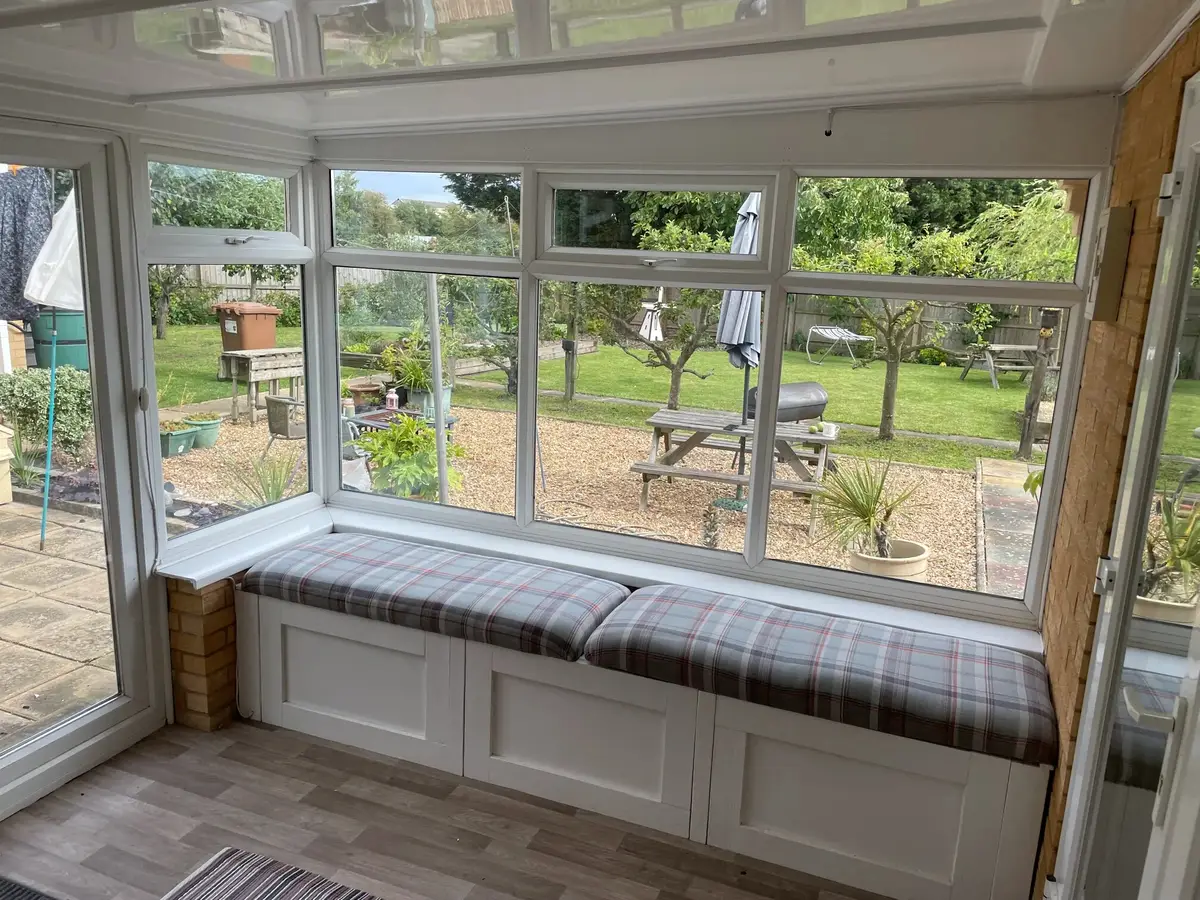
Panel thickness decides how well the roof insulates. With the same foam, a 25 mm core gives a U-value of about 1.14, 35 mm about 0.86, 50 mm about 0.62, 75 mm about 0.43 and 100 mm about 0.32. We fit 75 mm as standard because it cuts roof heat loss by about 80% against 16 mm polycarbonate without the bulk of thicker panels.
Why thickness matters more than anything else
An insulated roof panel is two aluminium skins bonded to a foam core. The skins give it strength and a weatherproof face, but they add almost nothing to the insulation. The foam does that job, and the amount of insulation you get depends almost entirely on how thick it is.
That makes thickness the single most useful number to ask about. Two panels can look identical from the garden, yet one may lose more than twice as much heat as the other because its core is half the depth.
How to work out a panel's U-value
You can check any panel with one line of maths. Take the core thickness in metres and divide it by the foam's thermal conductivity. For the extruded polystyrene (XPS) foam in our panels that conductivity is 0.034 W/mK. Add 0.14, which covers the still air films on the inside and outside faces of a roof. Then divide 1 by the total.
So the formula is U = 1 / (0.14 + t / 0.034), where t is the core thickness in metres. For our 75 mm panel that is 1 / (0.14 + 0.075 / 0.034) = 1 / (0.14 + 2.21) = 1 / 2.35, which comes to about 0.43 W/m²K.
Different foams have slightly different conductivity, so a panel with a different core will move a little either way. The shape of the curve stays the same.
The five common thicknesses compared
This table works the formula through for each size and puts it to work on a 12 m² roof. Heat loss is at 20°C inside and 0°C outside. Yearly figures use about 2,150 heating degree days, the England average to a base of 15.5°C, and the electricity price cap rate of 26.32p per kWh for October to December 2026.
| Foam core | U-value (W/m²K) | Heat loss, 12 m² roof | Heat lost per year | Cost per year on electricity | Cut against 16 mm polycarbonate |
|---|---|---|---|---|---|
| 16 mm polycarbonate (for reference) | 2.3 | 552 W | 1,424 kWh | £375 | None |
| 25 mm | 1.14 | 274 W | 706 kWh | £186 | 50% |
| 35 mm | 0.86 | 206 W | 533 kWh | £140 | 63% |
| 50 mm | 0.62 | 149 W | 384 kWh | £101 | 73% |
| 75 mm (our standard) | 0.43 | 103 W | 266 kWh | £70 | 81% |
| 100 mm | 0.32 | 77 W | 198 kWh | £52 | 86% |
The costs assume the room is kept warm through the whole heating season. If you heat it less, every figure drops, but the gaps between them stay in proportion.
What the table tells you
Thin panels are closer to polycarbonate than you might think
A 25 mm panel at 1.14 is better than 16 mm polycarbonate, but not dramatically better than 35 mm polycarbonate at about 1.4. If you are paying to take off a polycarbonate roof, a 25 mm panel leaves a lot of the benefit on the table.
Each extra 25 mm is worth less than the last
Going from 25 mm to 50 mm saves about 322 kWh a year on a 12 m² roof. Going from 50 mm to 75 mm saves about 118 kWh, worth about £31 a year at the electricity cap rate. Going from 75 mm to 100 mm saves about 68 kWh, or about £18. The first few centimetres do the heavy lifting.
Ask to see the sum
Under Approved Document L, 2021 edition, the target U-value for a new roof element is 0.15. Whoever you talk to, ask how their U-value figure was worked out and what the core is made of.
Why we fit 75 mm as standard
We chose 75 mm because it sits at the point where the gains are still large and the downsides are still small. Against 16 mm polycarbonate it cuts roof heat loss by about 80%, and against 25 mm polycarbonate by about 73%. The step up from 50 mm is still worth having, while the step to 100 mm adds far less.
A thicker panel also has practical costs. It is heavier, it needs deeper trims where it meets the gutter and the house wall, and it stands taller above the roof bars, which can clash with the wall above a lean-to or a low window upstairs. At 75 mm the panel stays light enough for most existing uPVC and aluminium frames, and the edges finish neatly on most conservatories.
The inner skin of a 75 mm panel also stays close to room temperature on a cold night, so condensation largely stops, and the foam core damps rain noise. Both of these benefits get weaker on thin panels because the inner face runs colder.
When comparing quotes, write the core thickness and the U-value side by side for each one. If a quote gives a U-value but no thickness, or the other way round, ask for both before you decide.
Where thickness is not the whole story
Thickness sets the insulation, but it does not make a good roof on its own. The panels need to be made to measure so they fit the bars without gaps, the seals need to be right, and the join with the house wall and gutters has to be weathertight. A thick panel fitted badly will leak air and water.
What a 75 mm panel roof costs
Prices include taking off and recycling the old roof, 75 mm panels made to measure in your colour, fitting and a 10 year insurance backed guarantee. Small roofs up to 12 m² start from £3,000, medium roofs of 12 to 25 m² from £4,000 and large or P-shaped roofs from £5,000. Most homes pay £3,000 to £7,500, which works out at about £250 to £450 per m² of roof.
You can compare these with other roof types on our conservatory roof panels cost page. The detail on what goes into each panel is on our insulated roof panels page, and the colour options are on roof panel colours.
Next steps
For a price range for your roof, use the conservatory roof cost calculator. To get the thickness, U-value and price in writing, book a free survey and we will measure up and give you a fixed quote.
Questions people ask
What thickness are most conservatory roof panels?
Many panels on the market have cores of 25 to 50 mm. We fit 75 mm as standard, which gives a U-value of about 0.43.
Is a 100 mm panel worth the extra?
On a 12 m² roof, going from 75 mm to 100 mm saves about 68 kWh a year, around £18 at the electricity cap rate. The panel is also heavier and taller at the edges, so for most conservatories 75 mm is the better balance.
Does a thicker panel make the room darker?
No. Any opaque panel blocks light from that part of the roof, whatever its thickness. Glazed roof lights set into the panel roof bring daylight back, and most people choose one or two.