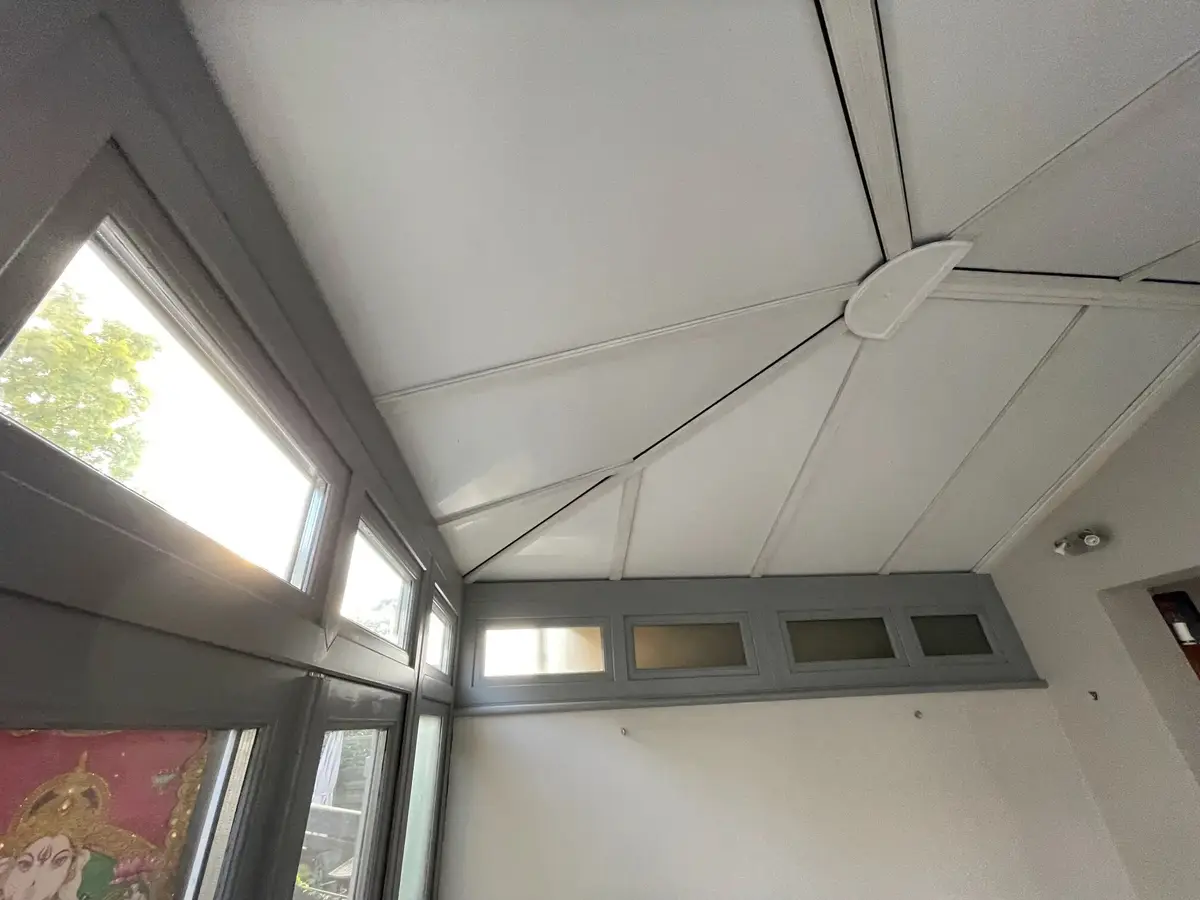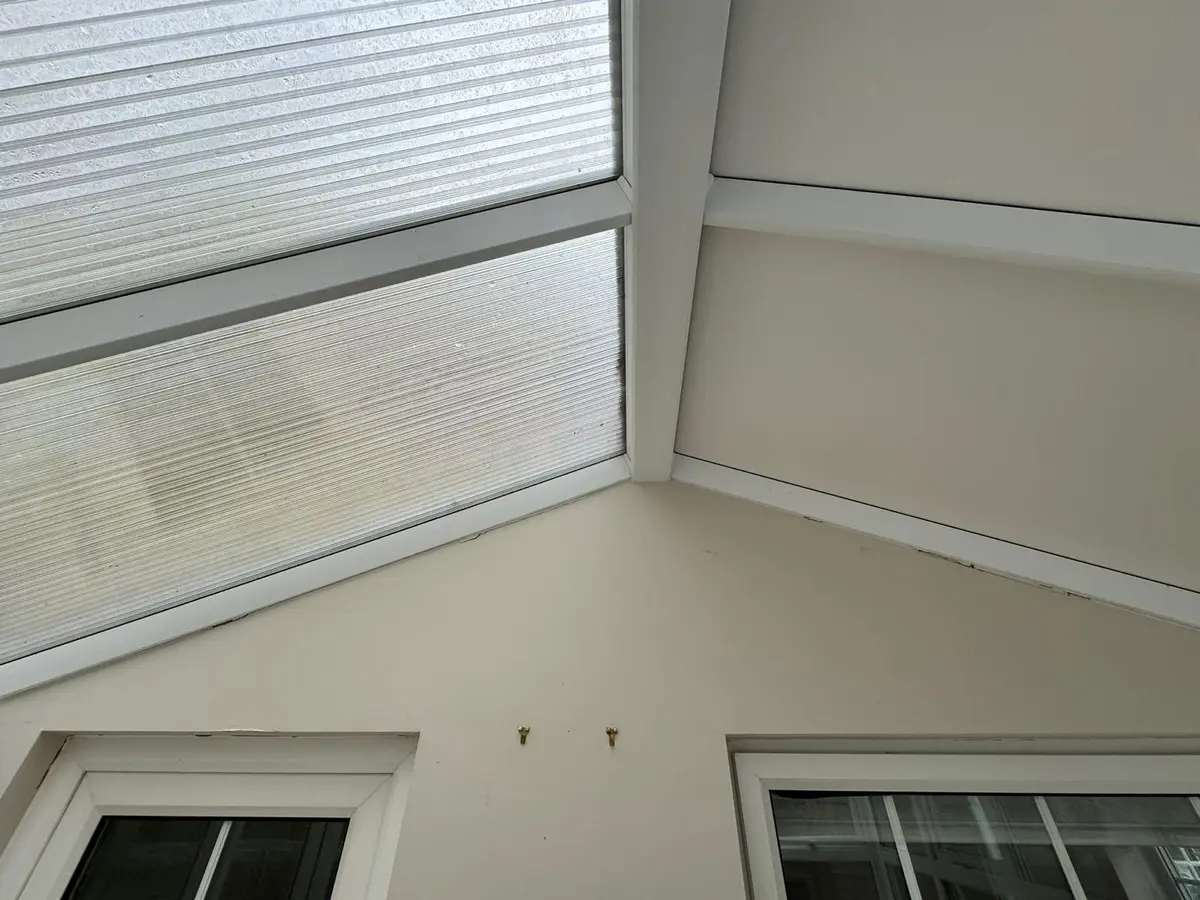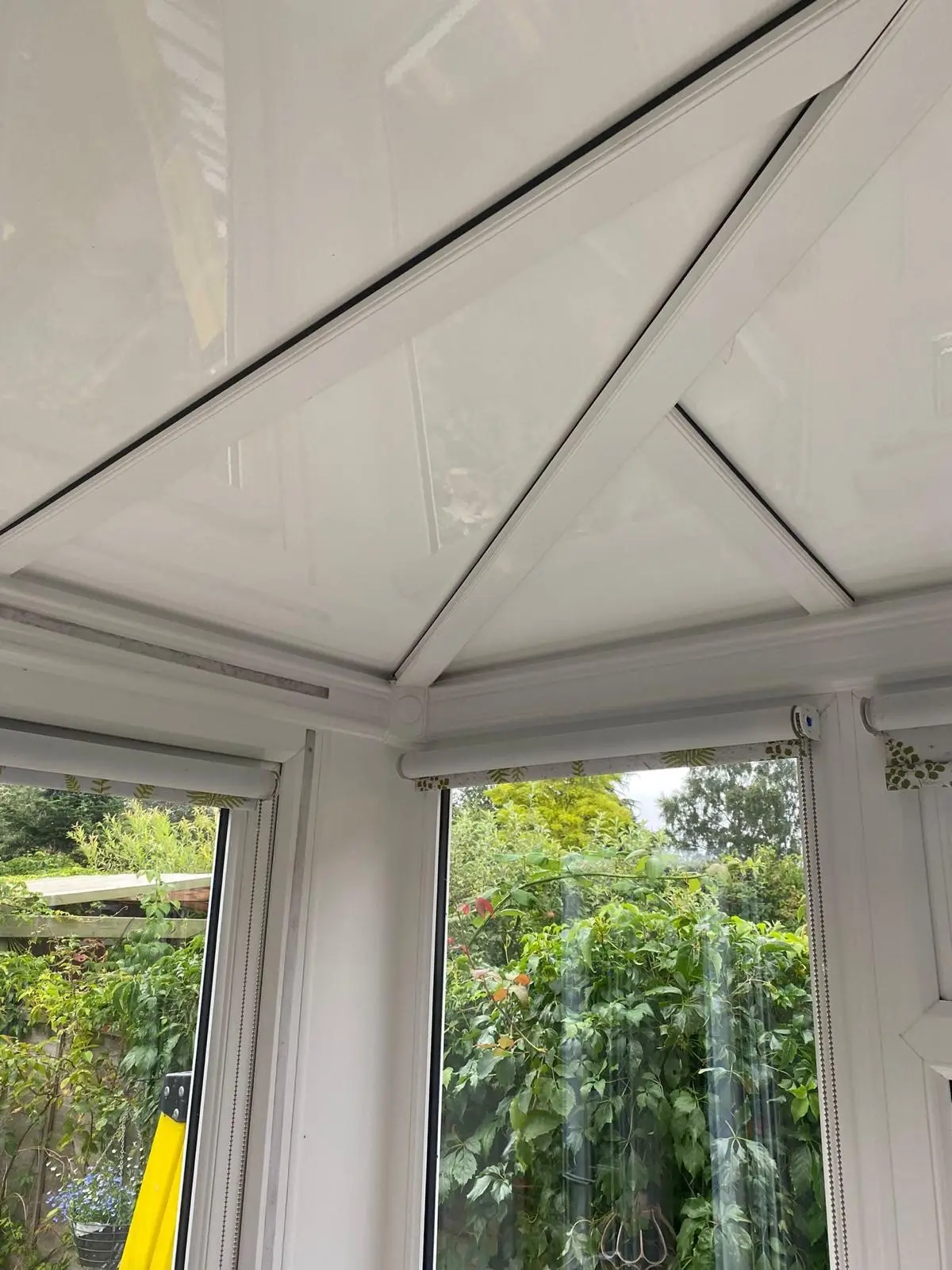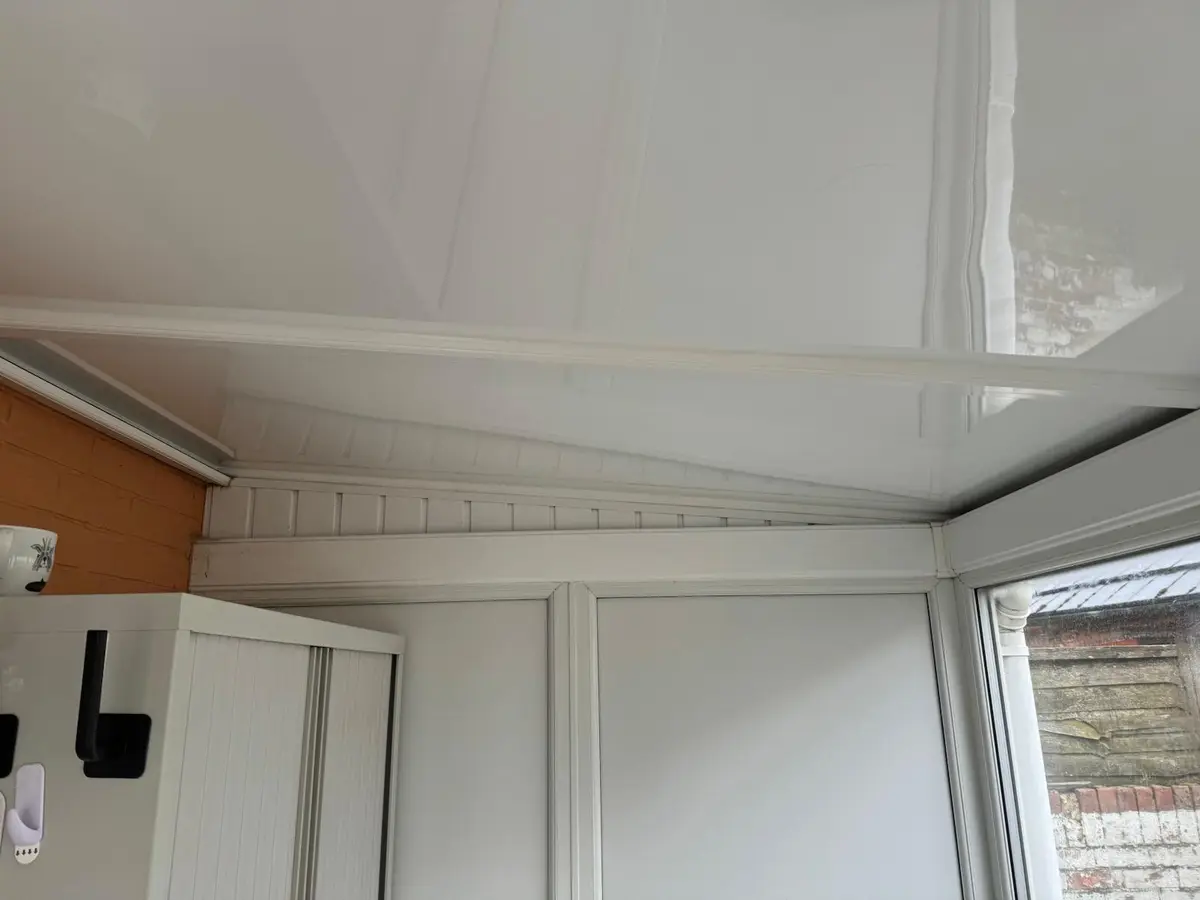
A U-value is the heat in watts that escapes through 1 m² of roof for every 1°C difference between inside and outside, so lower is better. Old double glazed roofs sit around 2.8, 16 mm polycarbonate about 2.3, modern low-e glass 1.0 to 1.2 and our 75 mm insulated panels about 0.43. The building regulations target for a new roof is 0.15.
What a U-value actually measures
A U-value tells you how easily heat passes through a building element. It is measured in watts per square metre per degree, written W/m²K. A roof with a U-value of 2.0 loses 2 watts through every square metre for each degree of difference between the room and the outside air.
That makes the sums easy. Heat loss in watts is the U-value times the area times the temperature difference. Double the area and you double the loss. Halve the U-value and you halve it.
The lower the number, the better the insulation. It is the opposite of most ratings, which is why U-values confuse people. A roof at 0.4 keeps heat in about five times better than one at 2.0.
Typical conservatory roof U-values
These are the figures we use across this site. The worked columns assume a 12 m² roof, which is typical for a medium lean-to or Edwardian conservatory.
| Roof | U-value (W/m²K) | Heat loss at 20°C in, 0°C out | Heat lost per year | Cost per year on electricity |
|---|---|---|---|---|
| Pre-2002 double glazed glass | 2.8 | 672 W | 1,734 kWh | £456 |
| 16 mm polycarbonate | 2.3 | 552 W | 1,424 kWh | £375 |
| 25 mm polycarbonate | 1.6 | 384 W | 991 kWh | £261 |
| 35 mm polycarbonate | 1.4 | 336 W | 867 kWh | £228 |
| Modern low-e roof glass | 1.0 to 1.2 | 240 to 288 W | 619 to 743 kWh | £163 to £196 |
| 75 mm insulated aluminium panel | 0.43 | 103 W | 266 kWh | £70 |
| Building regulations target, new roof | 0.15 | 36 W | 93 kWh | £24 |
Yearly heat loss uses U-value times area times heating degree days times 24, divided by 1,000. England averages about 2,150 heating degree days a year to a base of 15.5°C. Costs use the Ofgem price cap electricity rate of 26.32p per kWh for 1 October to 31 December 2026, and assume you keep the room warm right through the heating season. If you heat it only some evenings, the pounds fall but the ratios between the roofs stay the same.
How we work out our panel figure
Our panel has two aluminium skins bonded to a 75 mm solid foam core with a thermal conductivity of 0.034 W/mK. Almost all the insulation comes from the foam. The thin aluminium adds next to nothing.
To get a U-value, you add up the resistances to heat flow and take the reciprocal. The foam gives 0.075 divided by 0.034, which is about 2.21. The still air films on the inside and outside surfaces of a roof add a standard 0.14 between them. So the total is 2.35, and 1 divided by 2.35 is about 0.43 W/m²K.
We publish the sum so you can check it, and so you can check anyone else's. A panel with a 35 mm core of the same foam comes out at about 0.86, and a 25 mm core at about 1.14. Our guide to conservatory roof panel thickness lays out every common size.
What counts as a good U-value for a conservatory roof?
It depends on what you are comparing with. Against the roof most conservatories have now, the gains are large. Going from 16 mm polycarbonate at 2.3 to panels at 0.43 cuts roof heat loss by about 80%. From 25 mm polycarbonate at 1.6 the cut is about 73%.
The building regulations figure is the other yardstick. Under Approved Document L, 2021 edition, in force since June 2022, the target U-value for a new roof element is 0.15. Building control officers differ in how they apply it to a conservatory that keeps its existing frame and glazed walls, which is why the specification for your roof is agreed with them before anything is ordered.
What that means for building control
A conservatory is exempt from building regulations only while at least 75% of the roof and 50% of the walls are translucent, the floor area is under 30 m², and it is separated from the house by external quality doors with no fixed heating from the house system. Fitting a solid insulated roof removes the exemption, so approval is normally needed.
Building control officers vary in how they apply the 0.15 target to conservatory conversions. That is why we agree the specification with building control before ordering, and make the application on your behalf. You then get a completion certificate once the work is signed off. There is more in our guide to building regulations for solid conservatory roofs.
Things a U-value does not tell you
Solar gain
A U-value covers heat moving from warm to cold by conduction. It says nothing about sunlight. A glass roof at 1.1 lets direct sun straight into the room, which is why conservatories regularly pass 35 to 40°C in summer. An opaque insulated roof blocks direct sun on the roof, so it helps in July as well as January.
The frame and bars
Published U-values for sheets and panels are usually for the middle of the sheet. The aluminium or uPVC roof bars between them conduct heat more easily, so a whole roof performs a little worse than its centre figure. This applies to every roof type, so the comparison between them still holds.
Walls and floor
The roof is only one surface. The glazed walls, the floor and draughts round doors all lose heat too. The roof is usually the largest single area and the one that faces the sky, so it is where the biggest single gain is, but it is not the whole room.
Condensation
A low U-value keeps the inside surface warm. On a cold night the inside of 16 mm polycarbonate can drop well below room temperature, which is why it drips. The inner skin of an insulated panel stays close to room temperature, so condensation largely stops.
Questions to ask about any U-value you are quoted
- Is it for the whole roof or just the centre of a panel or sheet?
- What thickness and what insulation material is it based on?
- Has it been worked out or tested, and can you see the sum?
- Does building control accept it for your roof, and what if they want better?
If a figure looks too good for the thickness, ask how it was reached. Any foam of this type needs thickness to insulate, so a thin panel with a very low number deserves a second look.
Next steps
To see what the numbers mean for your size of roof, try the conservatory roof cost calculator, or read how our insulated conservatory roof panels are made. When you are ready, book a free survey and we will put the panel spec and U-value in writing on your quote.
Questions people ask
What is the U-value of a polycarbonate conservatory roof?
About 2.3 for 16 mm sheets, 1.6 for 25 mm and 1.4 for 35 mm. All of these are several times higher than an insulated panel roof.
What is the U-value of a glass conservatory roof?
Old double glazed roofs fitted before 2002 are about 2.8. Modern low-e roof glass is about 1.0 to 1.2.
Do your panels meet the 0.15 building regulations target?
No. Our 75 mm panel is about 0.43, and we never claim otherwise. We agree the specification with building control before ordering and apply on your behalf.
Is a lower U-value always better?
For keeping heat in, yes. It does not cover summer sun, so an opaque insulated roof also has an advantage over glass in hot weather that the U-value alone does not show.