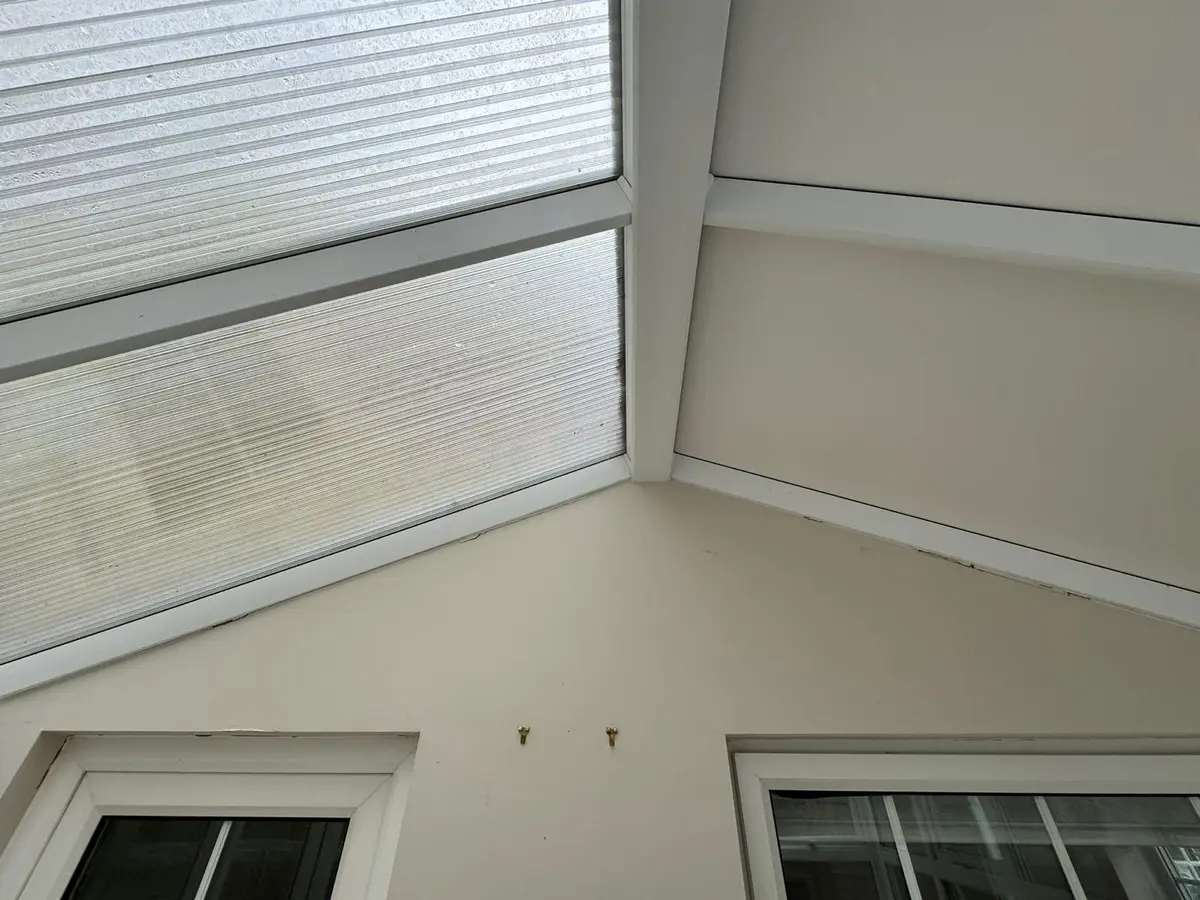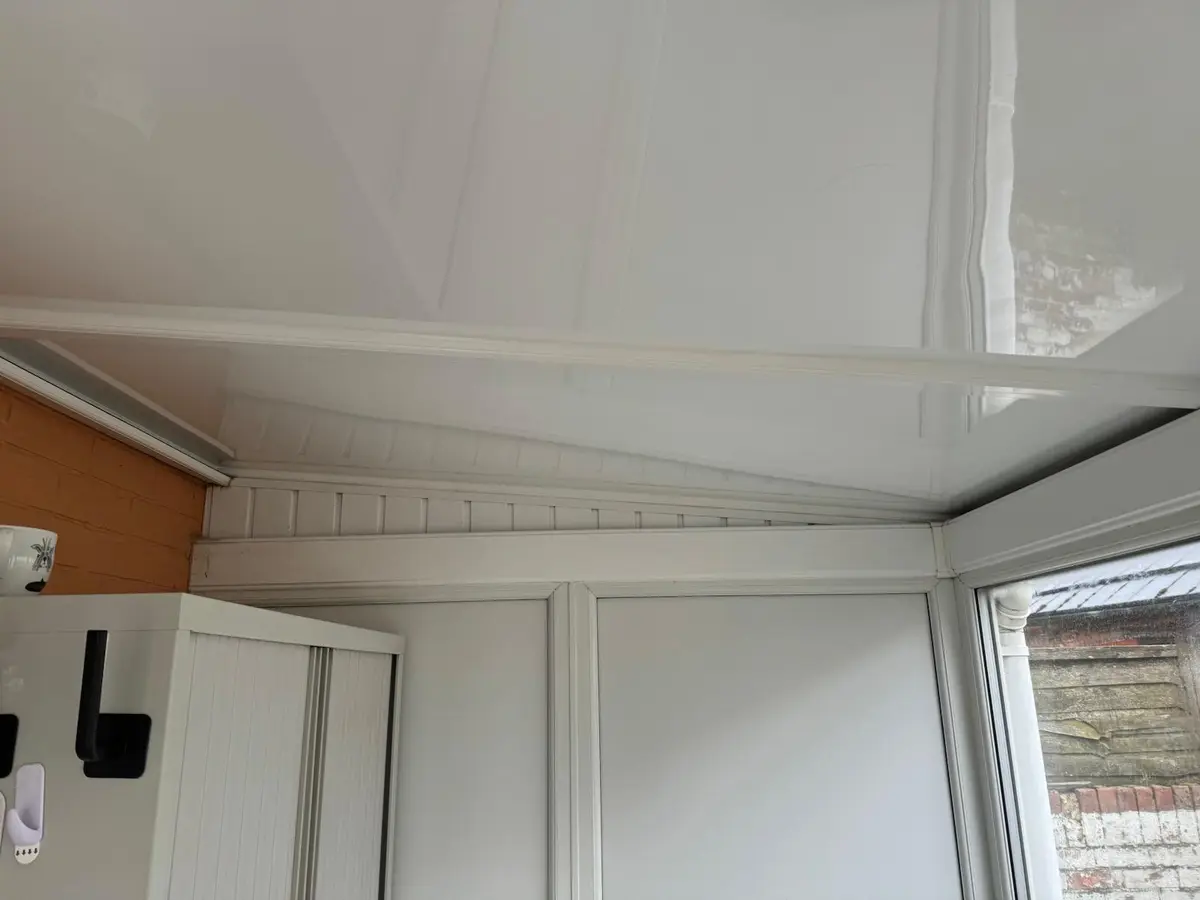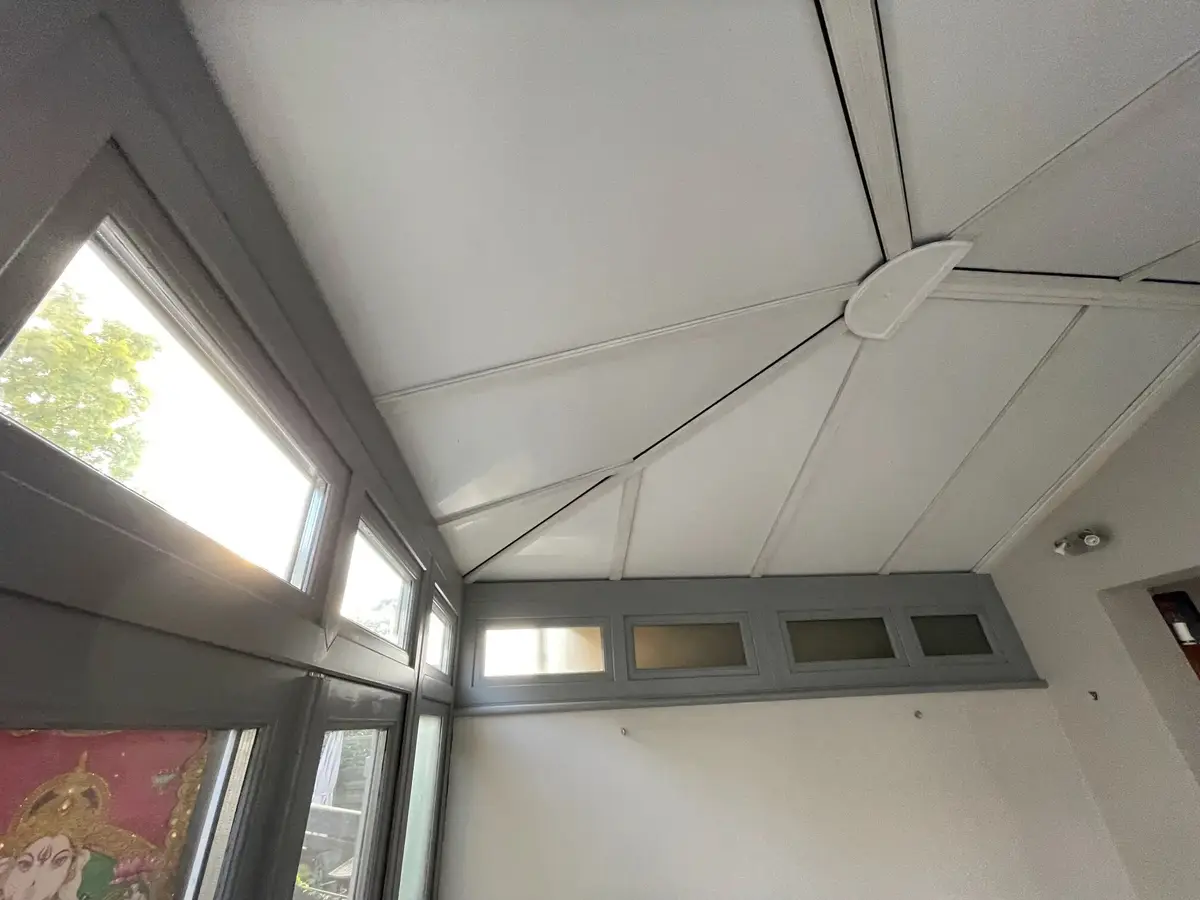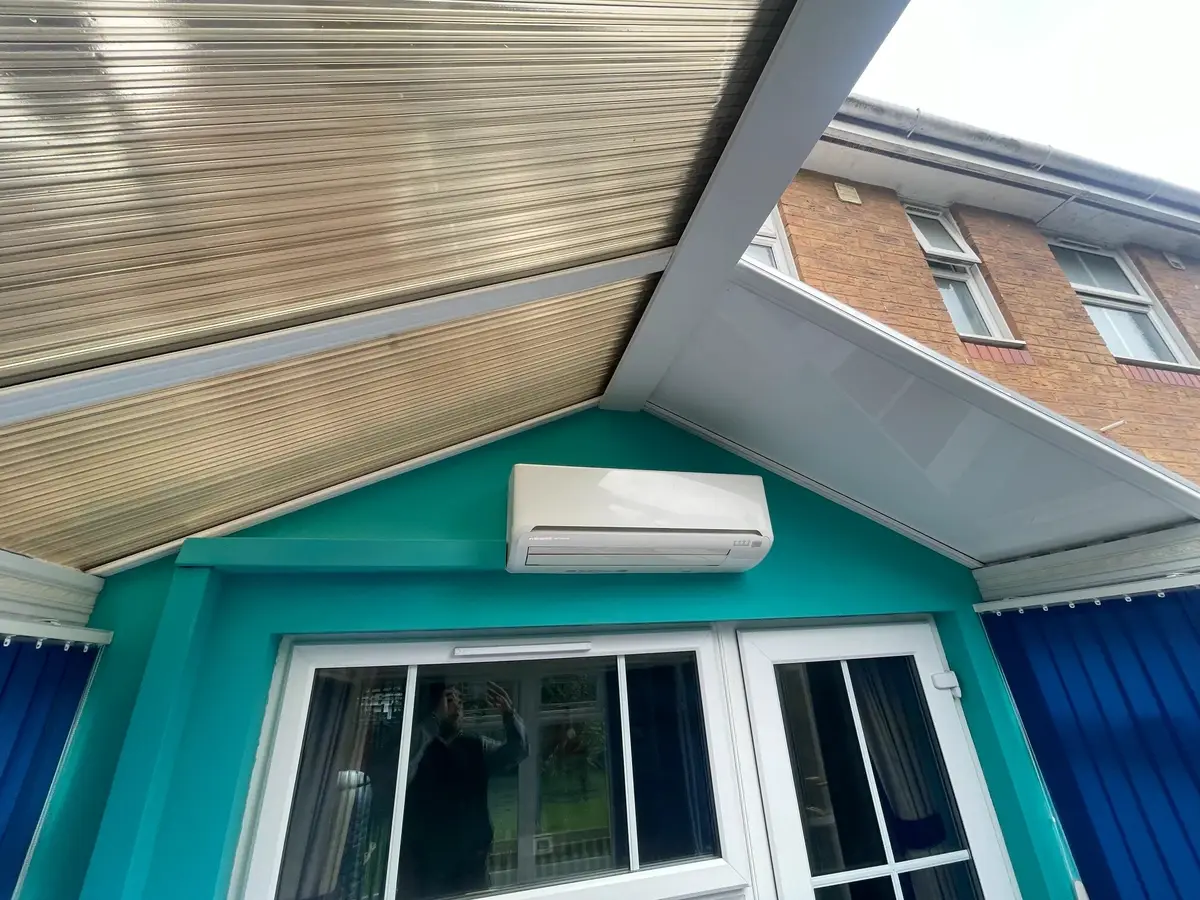
Insulated panels win on warmth, summer comfort, condensation and rain noise. Polycarbonate wins on daylight and upfront price. A 75 mm panel has a U-value of about 0.43 W/m²K against 2.3 for 16 mm polycarbonate, so a 12 m² roof loses 103 W instead of 552 W on a freezing night. New polycarbonate costs £2,000 to £3,500 for a 3 m by 3 m roof; panels start at £3,000.
If your polycarbonate roof has gone yellow, started leaking or drips every winter morning, there are two sensible ways forward. You can put new polycarbonate in the same frame, or you can replace it with insulated panels. Both reuse the existing frame. They lead to very different rooms, so here is how they compare on the things that matter.
The comparison at a glance
| New polycarbonate (16 to 35 mm) | 75 mm insulated panels | |
|---|---|---|
| U-value (W/m²K) | 2.3 (16 mm), 1.6 (25 mm), 1.4 (35 mm) | About 0.43 |
| Heat loss, 12 m² roof, 20°C in, 0°C out | 552 W, 384 W, 336 W | 103 W |
| Price | £2,000 to £3,500 for 3 m x 3 m | From £3,000 up to 12 m², from £4,000 for 12 to 25 m² |
| Daylight | High, diffused | Opaque, roof lights add light back |
| Summer heat | Direct sun through the roof, rooms pass 35 to 40°C | No direct sun through the roof |
| Condensation | Common on cold mornings | Largely stops |
| Rain noise | Loud drumming | Damped by the foam core |
| Building control | Not needed for like for like | Needed, we apply for you |
| Fitting time | Similar to panels | 1 day small, up to 2 to 3 days large |
| Look | Clear, bronze or opal sheets | Any RAL colour outside, white inside |
Warmth: the numbers
A U-value tells you how many watts leak through each square metre for every degree between inside and outside. The lower the number, the warmer the room. Moving from 16 mm polycarbonate to a 75 mm panel cuts roof heat loss by about 80%. Moving from 25 mm polycarbonate cuts it by about 73%.
Upgrading to thicker polycarbonate helps, but less than people expect. Going from 16 mm to 35 mm brings the U-value from 2.3 to 1.4, a 39% cut. The room is still losing more than three times as much heat through the roof as it would with panels.
| Roof on a 12 m² conservatory | Watts lost at a 20°C difference | kWh lost per year | Cost per year on electricity (26.32p) |
|---|---|---|---|
| 16 mm polycarbonate | 552 W | 1,424 | £375 |
| 25 mm polycarbonate | 384 W | 991 | £261 |
| 35 mm polycarbonate | 336 W | 867 | £228 |
| 75 mm insulated panels | 103 W | 266 | £70 |
The yearly figures use U x area x 2,150 degree days (the England average) x 24 / 1,000, and assume the room is heated through the winter. Electricity is at the Ofgem price cap for 1 October to 31 December 2026.
Ten year cost: a worked example
Price is where polycarbonate looks better, so it is worth running the sums over time. Take a 12 m² roof that you heat with an electric heater through the winter.
- New 25 mm polycarbonate: say £2,750 fitted, plus £261 a year of roof heat loss. Over 10 years: £2,750 + £2,610 = £5,360.
- 75 mm panels: from £3,000 fitted, plus £70 a year. Over 10 years: £3,000 + £700 = £3,700.
If you only heat the room occasionally, the gap shrinks, and if you heat with gas it shrinks further. It does not reverse unless the room is barely used in winter. Add a £395 roof light to the panel roof and it is still ahead on these numbers.
Daylight: where polycarbonate wins
This is the real trade-off, and we will not pretend otherwise. Polycarbonate lets a lot of diffused light through the roof. Panels let none through, so the room will be darker, especially at the back next to the house wall. Most people fit one or two glazed roof lights to put overhead light back, and the glazed walls still let in plenty. Our guide on whether a solid roof makes a conservatory dark works through the numbers.
On the plus side, the glare goes. Screens and televisions become usable at midday, and fabrics stop fading as fast under the roof.
Summer heat
Bronze and opal polycarbonate cut glare, but they still let solar heat into the room, and the sheet itself heats up and radiates downwards. That is why polycarbonate conservatories regularly pass 35 to 40°C. An opaque insulated roof blocks direct sun on the roof completely, and the 75 mm foam core stops heat soaking through from the hot outer skin. For more, see how to keep a conservatory cool in summer.
Condensation and noise
The inside face of a polycarbonate roof is cold in winter. On a 0°C night with 20°C inside, a 16 mm sheet's inner surface sits around 15°C, and room air at 75% humidity will condense on it and drip. The inner skin of a 75 mm panel stays at about 19°C, so condensation largely stops.
Rain is the other daily difference. Hollow polycarbonate drums under heavy rain and hail. The foam core in a panel damps it, so rain becomes a soft background sound rather than something you turn the television up for.
Building control: a point for polycarbonate
Replacing polycarbonate with new polycarbonate keeps the conservatory exempt from building regulations, because at least 75% of the roof stays translucent. Fitting panels removes the exemption, so building control approval is needed. We make the application, agree the spec with building control before ordering, and the cost is included in our price. It adds some lead time, which is part of our typical 3 to 5 weeks from survey. Read more in our building regulations guide.
Looks and upkeep
Polycarbonate discolours and turns brittle as sunlight breaks down the surface, and dirt collects in the channels at the ends of the sheets. Panels have a powder coated aluminium outer skin in any RAL colour, with anthracite grey and white the most popular. A wipe down and clear gutters are all they need. See the roof panel colours page for options.
Which should you choose?
Choose new polycarbonate if
- You use the room mainly in spring and autumn and value light above everything.
- The conservatory faces north or is heavily shaded, so it rarely overheats.
- Your budget is under £3,000 and the roof simply needs to stop leaking.
Choose insulated panels if
- You want to use the room every day of the year.
- It overheats in summer, drips in winter or is too loud in the rain.
- You heat it for several months a year and want that heat to stay in.
Next step
See our page on replacing a polycarbonate conservatory roof, try the cost calculator, or ask for a free survey and fixed quote.
Questions people ask
Is 35 mm polycarbonate as good as insulated panels?
No. 35 mm polycarbonate is about 1.4 W/m²K, more than three times the heat loss of a 75 mm panel at about 0.43.
Can I keep some polycarbonate and add panels?
The panel roof uses glazed roof lights rather than strips of polycarbonate. Most people choose one or two to keep daylight.
Do I need building regulations to replace polycarbonate with polycarbonate?
No. Like for like translucent sheets keep the conservatory exempt. Switching to panels removes the exemption, and we apply for approval on your behalf.
Which is quieter in the rain?
Panels, by a long way. The foam core damps rain noise that hollow polycarbonate amplifies.