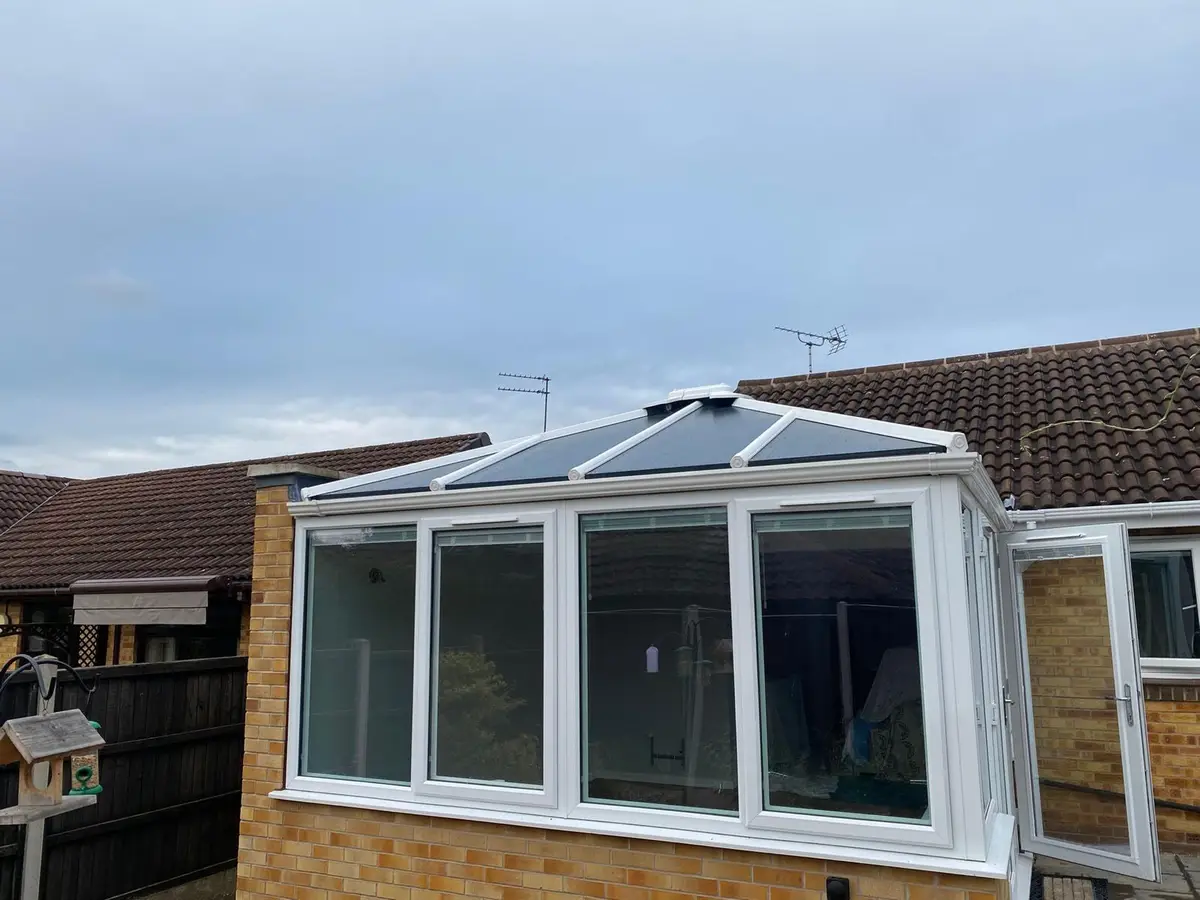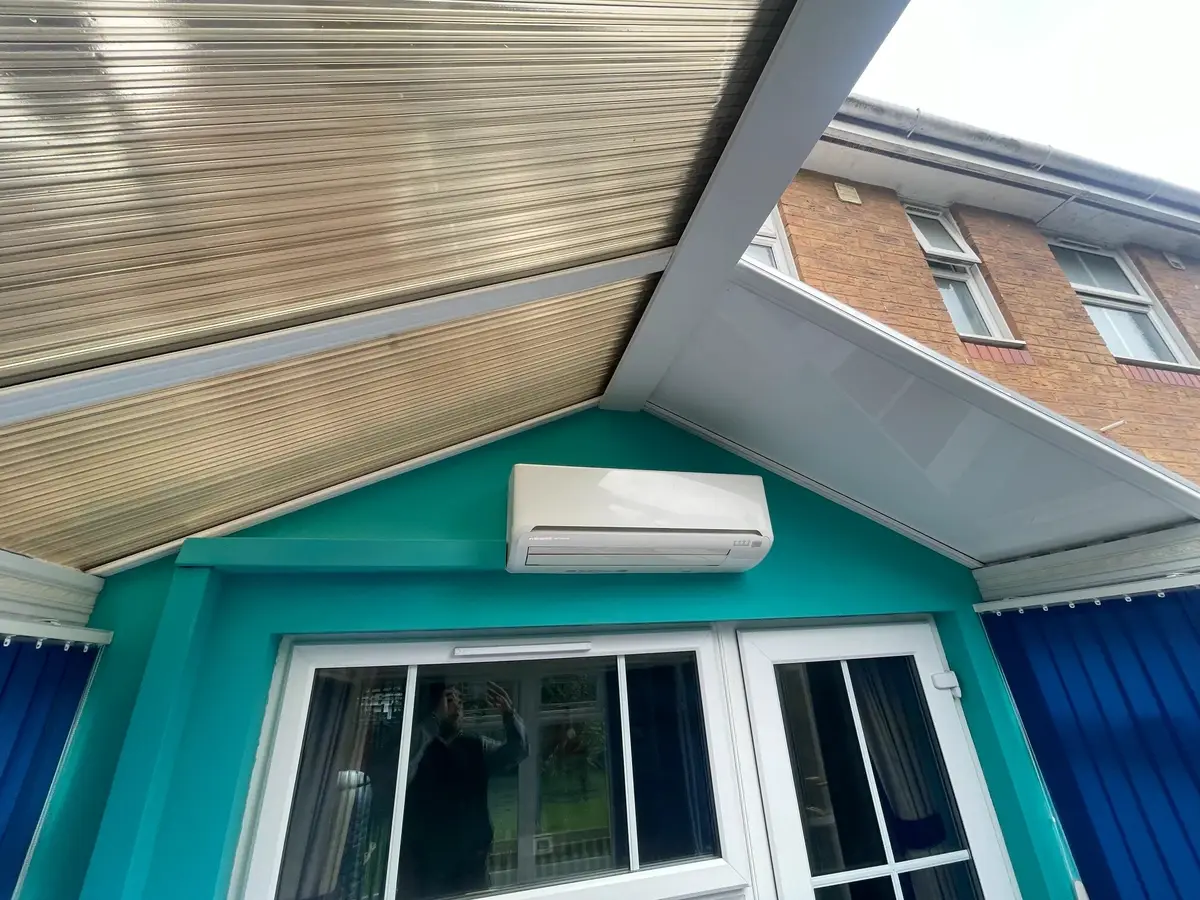
You can replace a polycarbonate conservatory roof with insulated panels without changing the frame. The old sheets come off, made-to-measure 75 mm panels go on, and heat loss through the roof falls by about 80 percent against 16 mm polycarbonate. Most roofs take 1 to 2 days, and fitted prices start from £3,000 including the building control application.
Why polycarbonate roofs give up
Polycarbonate was fitted to a great many UK conservatories because it was light and cheap. It is a twin, triple or multiwall plastic sheet, and the air gaps inside it are its only insulation. Over the years the sun breaks down the surface, and the problems below tend to arrive together.
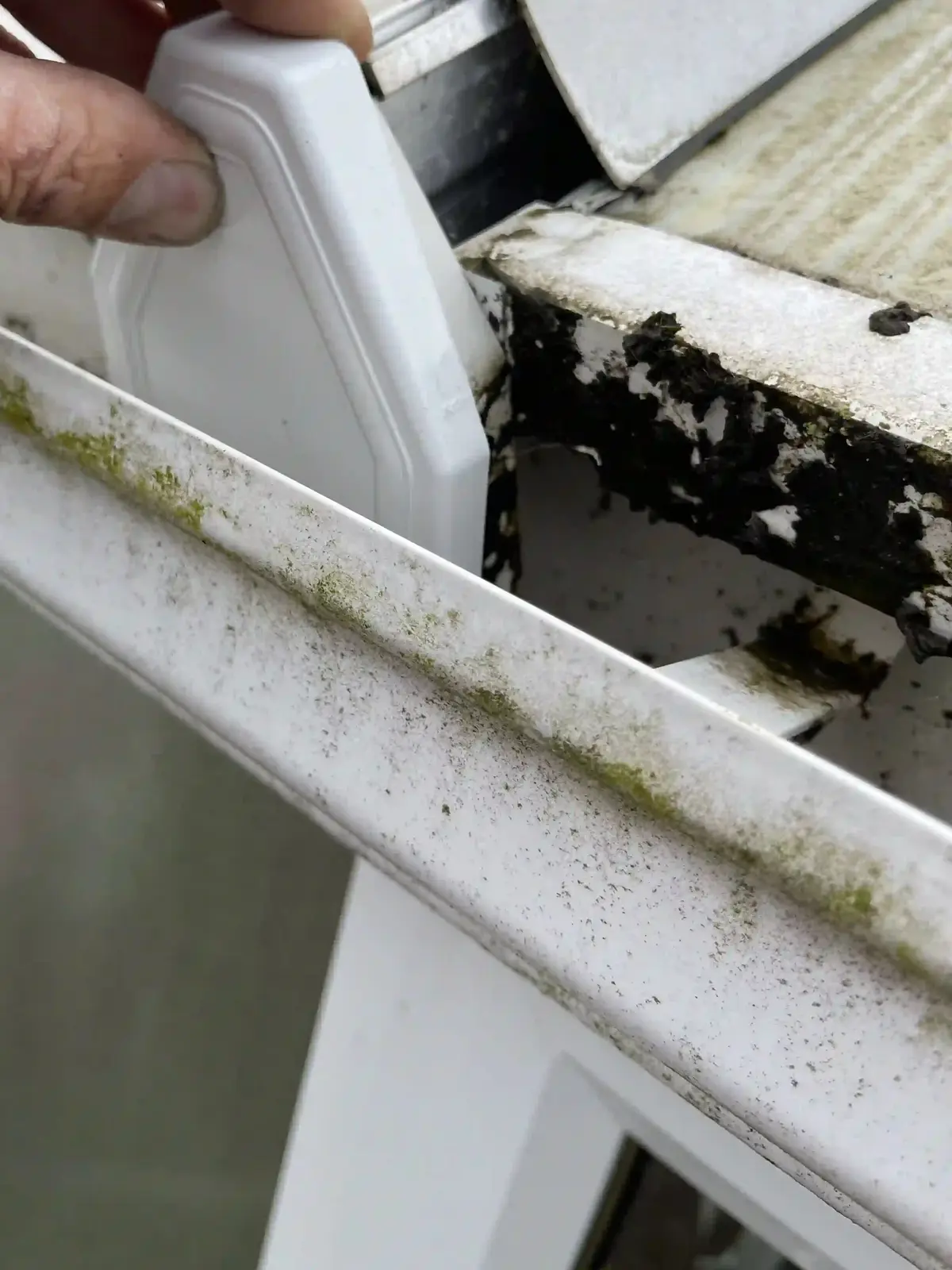
- Yellowing and cloudiness: the sheets lose their clarity, and green or black mould grows in the channels where dirt gets in.
- Leaks: seals at the glazing bars shrink and crack, so water runs in at the bars and the house wall.
- Slipping sheets: sheets creep down the slope towards the gutter and open gaps at the top.
- Condensation: the inner face is cold in winter, so moisture from the room condenses on it and drips.
- Noise: rain and hail on a thin plastic sheet sound like a drum.
If two or three of those sound familiar, the roof is near the end of its useful life. Our guide to the signs a conservatory roof needs replacing helps you judge how far gone yours is.
Why not just fit new polycarbonate?
You can, and new sheets for a 3 m by 3 m roof cost about £2,000 to £3,500 fitted. The trouble is that new polycarbonate performs exactly like the old did on day one. It has the same U-value, the same rain noise and the same condensation, so you pay to keep the problems you have now.
| Roof covering | U-value (W/m²K) | Heat loss cut by our panels |
|---|---|---|
| 16 mm polycarbonate | about 2.3 | about 80 percent |
| 25 mm polycarbonate | about 1.6 | about 73 percent |
| 35 mm polycarbonate | about 1.4 | about 69 percent |
| Our 75 mm insulated panels | about 0.43 | n/a |
For a side by side on light, weight, noise and cost, read our comparison of insulated roof panels and polycarbonate.
What you notice after the change
The room stays warm
On a winter evening with 20°C inside and 0°C outside, a 12 m² roof of 16 mm polycarbonate loses about 552 W. The same roof in our panels loses about 103 W. Across a heating season in England, that is roughly 1,424 kWh a year down to about 266 kWh if the room is kept warm.
Summer becomes bearable
Clear and opal polycarbonate both let the sun's heat through, which is why conservatories so often pass 35 to 40°C in summer. An opaque insulated roof blocks direct sun on the roof, so the room no longer bakes by mid afternoon.
Quiet, dry ceilings
The inner skin of each panel stays close to room temperature, so condensation largely stops. The 75 mm foam core damps rain noise, which many people notice on the first wet night.
How we swap polycarbonate for panels
- We protect the room, then lift off the caps, the old sheets and their seals.
- We check each glazing bar, the ridge and the gutter beam. Anything damaged is flagged before we go further.
- The panels, made to your survey measurements, are laid on the bars and clamped under new caps with new seals.
- Trims go on at the ridge, the hips and the house wall, and the gutters are cleared or renewed.
- The old polycarbonate is taken away and recycled.
Panels weigh more than polycarbonate sheets, so the frame check matters. They are still light enough for most uPVC and aluminium conservatory frames, and our guide on whether your frame can take a solid roof explains what we look at. A small lean-to or Edwardian is usually done in 1 day, a medium roof in 1 to 2 days, and a large roof or P-shape in 2 to 3 days, normally without scaffold.
Before the survey
You do not need to prepare much, but a few notes help us give you an accurate quote. Write down where the roof leaks and after what kind of weather, and take photos of any stains on the bars or walls. If you know roughly when the conservatory was built, or have old paperwork for it, have that to hand.
It also helps to know how you want to use the room. A dining room, an office and a playroom all need light in different places, and knowing your plans helps us place roof lights and spotlights where they are useful.
What it costs
Fitted prices start from £3,000 for a small roof, £4,000 for a medium roof and £5,000 for a large one, and most homes pay £3,000 to £7,500. That includes taking away the old roof, the panels in your colour, fitting, the building control application and a 10 year insurance backed guarantee. Enter your size and style below for a guide figure.
Popular extras are glazed roof lights at £395 each, LED spotlights at £345 and new gutters and fascia at £295. The full breakdown is on our roof panel prices page.
Building control and planning
A conservatory is only exempt from building regulations while at least 75% of the roof and 50% of the walls are translucent, among other conditions. Swapping polycarbonate for an insulated roof takes it out of that exemption, so building control approval is normally needed. We agree the specification with building control before ordering, make the application for you, and pass on the completion certificate at the end.
Keep the completion certificate with your house deeds. A buyer's solicitor will ask for it, and it is much harder to get one after the event.
Planning permission is not normally needed because the footprint and height do not change. Check with the council first if you are in a listed building, a conservation area, a national park or a National Landscape.
Questions people ask
How long does a polycarbonate conservatory roof last?
It varies with the grade of sheet and how much sun it gets, but many roofs fitted in the 1990s and 2000s now leak, have yellowed or have sheets that slip. Once the seals and sheets start to fail together, replacement usually costs less than repeated repairs.
Can I swap just a few polycarbonate sheets for panels?
It is rarely worth doing. The roof would still lose heat and drip through the remaining sheets, and the change would still need building control approval, so most people replace the whole covering at once.
Is it worth replacing 35 mm polycarbonate?
Yes, if the room is still cold or noisy. Our panels cut heat loss through the roof by about 69 percent against 35 mm sheets, from a U-value of about 1.4 down to about 0.43.
Can I replace polycarbonate with glass instead?
You can, and modern low-e roof glass has a U-value of 1.0 to 1.2. It costs around £3,300 to £5,200 for a 3 m by 3 m roof and still lets in the summer heat, which is why most people choosing now go for insulated panels.
Do you take the old polycarbonate away?
Yes. Removal of the old roof is included in every price, and the old sheets and caps are taken away and recycled.